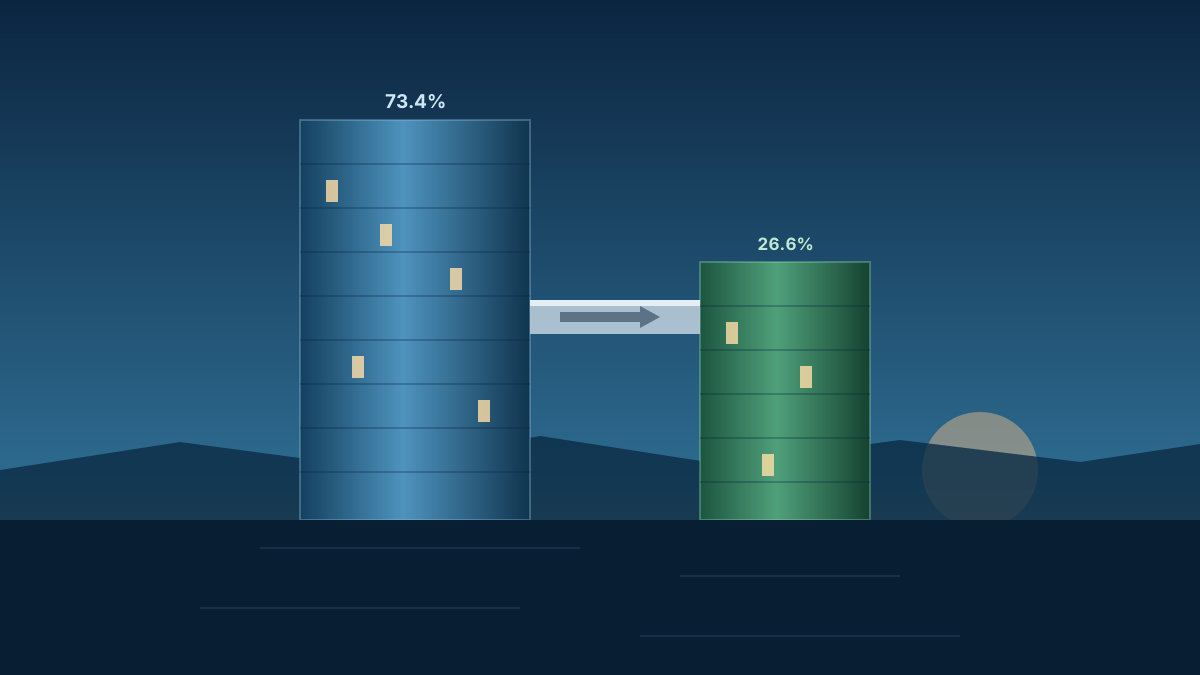
ITC Infotech will absorb Happiest Minds Technologies in a share swap that values the smaller company at ₹6,167 crore and gives ITC Limited 73.4% of the combined business.
Happiest Minds shares fell about 9% on the announcement. ITC rose about 5%.
That divergence is the story. The market read the same document twice and concluded that one side had bought well.
Who is being combined
Happiest Minds was founded in 2011 by Ashok Soota, who had already built one Indian IT company and co-founded another. It listed in 2020 into one of the more enthusiastic receptions an Indian mid-cap IT issue has had, and positioned itself deliberately at the digital end of the market rather than competing on headcount. Soota remains Chairman and Chief Mentor.
ITC Infotech is the technology arm of ITC Limited, unlisted, and built around enterprise transformation, SAP, engineering services and product lifecycle management. It is a subsidiary of a conglomerate whose value is set almost entirely elsewhere: cigarettes, FMCG, hotels and paper.
The complementarity claim is therefore reasonable on paper. Soota's stated case is that combining Happiest Minds in AI, digital, cloud, data, cybersecurity and product engineering with ITC Infotech in enterprise transformation, SAP and PLM produces a portfolio neither could assemble alone. Both sides describe an "AI-first" enterprise targeting around $1 billion by FY28.
The terms
The transaction runs in two stages. ITC Infotech first acquires roughly 22.1% of Happiest Minds from Ashok Soota and Ashok Soota Medical Research LLP across two tranches, for ₹1,330 crore, funded through a rights issue. Happiest Minds then merges into ITC Infotech, which becomes a listed technology services company in the process.
The companies say completion will take about fifteen months and that both will operate independently until every approval is in: the Competition Commission, the exchanges, the National Company Law Tribunal and shareholders.
The stated ambition is around $1 billion in revenue by FY28.
Why the shares moved in opposite directions
The complaint from Happiest Minds holders is that there is almost no premium. ₹405 a share against a stock that had already spent a long stretch under pressure is not the number an owner hopes to see on a takeover.
The premium objection is real but incomplete, and the more interesting reading runs the other way.
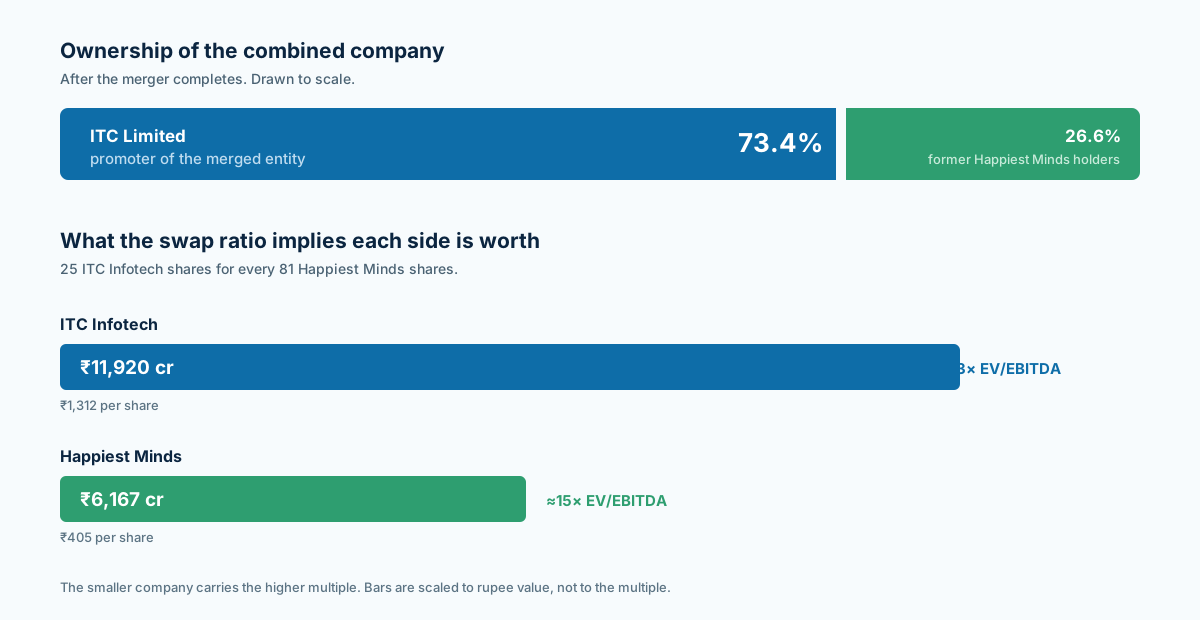
At ₹6,167 crore Happiest Minds is being valued at roughly 15 times EV/EBITDA. ITC Infotech, at ₹11,920 crore, is being valued at a little over 13 times. The smaller company is carrying the higher multiple. Whatever else this swap is, the exchange ratio does not treat Happiest Minds as the weaker asset; it treats it as the better-rated one.
So why did the stock fall?
Because a swap ratio is not a price. A Happiest Minds holder does not receive ₹405; they receive 25 ITC Infotech shares for every 81 they hold, and what those are worth depends entirely on where ITC Infotech trades once it is listed, which nobody knows, because it has never been listed. The holder has exchanged a liquid, priced, publicly traded position for a claim on an unlisted entity that will be priced by a market fifteen months from now.
That is a genuine transfer of risk, and it is not compensated by a premium. The discount is the price of the uncertainty, and the market applied it immediately.
ITC's 5% rise is the mirror image. ITC shareholders acquire a larger technology business without writing a cheque of consequence, and gain an eventual listing that puts a public price on an asset currently buried inside a conglomerate whose value is set by cigarettes, FMCG, hotels and paper.
The founder is selling, and that is worth stating plainly
The first leg of this transaction is not a merger at all. It is Ashok Soota and Ashok Soota Medical Research LLP selling roughly 22.1% of Happiest Minds to ITC Infotech for ₹1,330 crore in cash, at about ₹395 a share.
Founder exits are not scandals, and Soota is entitled to sell what he built. But the sequencing tells a reader something the press release does not emphasise: the promoter takes cash at ₹395 while public shareholders take paper priced at ₹405 in an unlisted entity. Those are not the same consideration, and the difference is liquidity, the thing the minority is giving up and the promoter is receiving.
An investor deciding whether the swap is fair should weigh that alongside the multiple. A 15× EV/EBITDA mark is defensible. Receiving it in a currency you cannot sell for fifteen months is a different proposition from receiving it in cash.
The purchase is funded through a rights issue at ITC Infotech, which means ITC Limited is putting fresh capital in as the majority holder: a detail worth noting, because it is the clearest signal available that the parent intends to back this rather than simply consolidate it.
The consolidation this sits inside
Mid-tier Indian IT has been running out of room for several years. The largest firms compete for transformation programmes on the strength of balance sheet and delivery scale; the smallest compete on price. The middle has the worst of both: too large to be nimble, too small to be shortlisted for the deals that justify the overhead.
The standard responses have been to specialise deeply, to be acquired, or to merge. Happiest Minds specialised, successfully, and then found that specialisation does not by itself deliver the deal sizes the public market had priced in. The stock's prolonged weakness before this announcement is the market reaching that conclusion ahead of the board.
Read that way, this is less an opportunistic purchase than the predictable resolution of a structural squeeze. Which is also why the $1 billion target deserves scrutiny rather than applause: two companies that individually could not reach the deal sizes they wanted do not automatically reach them together.
What actually has to work
A merger creates a larger company on the day it closes. It creates a better one only if the integration does something neither side could do alone.
Three things determine whether this was a good transaction, and none of them is the swap ratio.
- Getting to $1 billion. The combined revenue target for FY28 requires
winning larger contracts than either firm wins today. Mid-tier Indian IT has spent a decade discovering that scale in headcount does not automatically produce scale in deal size.
- Converting AI capability into enterprise engagements. Both sides describe
AI, cloud, data and cybersecurity capability. Every competitor describes the same capability. The differentiator is not the capability, it is the client relationship deep enough to be trusted with a transformation programme.
- The integration itself. Happiest Minds was built by Ashok Soota around a
specific culture and a founder's presence. ITC Infotech is a subsidiary of one of India's largest conglomerates. These are not the same organism, and the people who make mid-tier IT work are mobile.
The part that is easy to miss
For ITC Limited shareholders this is not an earnings event. Cigarettes, FMCG, hotels and paper will continue to be what the company is. A technology services arm of even $1 billion is a rounding adjustment against that base.
What it is instead is an option. If the combined entity scales, ITC owns 73.4% of a listed technology business with a visible market price: an asset it can partially monetise, use as acquisition currency, or simply have re-rated by investors who value technology services differently from tobacco.
That is a sensible piece of corporate structuring. It is also the reason to be sceptical of the $1 billion headline: the transaction makes sense for ITC whether or not the revenue target is met, which means the target is doing less work in the decision than it appears to be doing in the press release.
What to watch
The approvals are procedural but not trivial, fifteen months is long enough for market conditions and key people to change. The number to watch before then is attrition at Happiest Minds, particularly among client-facing leadership. In services businesses the assets have opinions about being acquired, and they leave before the NCLT hearing, not after it.
Terms are from the companies' exchange disclosures and press release. Share price moves and implied valuations are as reported by Business Today and contemporaneous coverage. Valuation multiples are as reported. Sections marked analysis are the author's assessment. Nothing here is investment advice.


